Brewing Cash: Flipping Discontinued Single-Serve Coffee Makers for Parts

The Hidden Value in Dead Appliances
When most resellers see a dusty, potentially broken coffee maker at a thrift store, they walk right past it. They assume testing it will be a hassle, shipping will be a nightmare, and the profit margin isn't worth the risk.
However, there is a massive, highly profitable secondary market for discontinued single-serve coffee makers, specifically for their individual components. People become attached to their specific machines, and when a single part breaks, they'd rather pay $25 for a replacement water reservoir than $150 for a brand new machine.
Top Brands to Look Out For
Not every old coffee maker is worth your time. Focus on brands with proprietary pod systems or high-end models that have been discontinued but still have a dedicated user base.
1. Bosch Tassimo
Tassimo machines (which use T-Discs instead of K-Cups) have a very loyal following, but many of the older, robust models (like the T55 or T65) are no longer made. Their parts are in extremely high demand.
2. Older Keurig Models (Pre-Keurig 2.0)
When Keurig introduced the "2.0" system that used DRM (Digital Rights Management) to lock out third-party coffee pods, there was massive consumer backlash. Because of this, older models (like the B60 or K45) that can brew any K-Cup are still highly sought after.
3. Nespresso (OriginalLine)
While VertuoLine is newer, the OriginalLine machines (which use the classic, smaller bell-shaped capsules) are prized for making superior espresso. Discontinued models, especially those made by Breville or De'Longhi, hold their value exceptionally well.
How to Part Out a Coffee Maker
If you find a high-value discontinued machine for $5 at Goodwill, you don't even necessarily need it to power on to make a profit. You can often quadruple your money by "parting it out."
Here are the most valuable components to strip and sell individually:
- The Water Reservoir (Tank): This is the #1 most frequently broken or lost part. A clean water tank for a discontinued Tassimo or Keurig can easily sell for $20 to $40 on its own.
- The Reservoir Lid: Often lost during moving or cleaning. Easy to ship and usually sells for $10-$15.
- The Drip Tray and Grate: The metal grate gets scratched or rusted, and the plastic tray gets gross. A pristine set is an easy $15-$25.
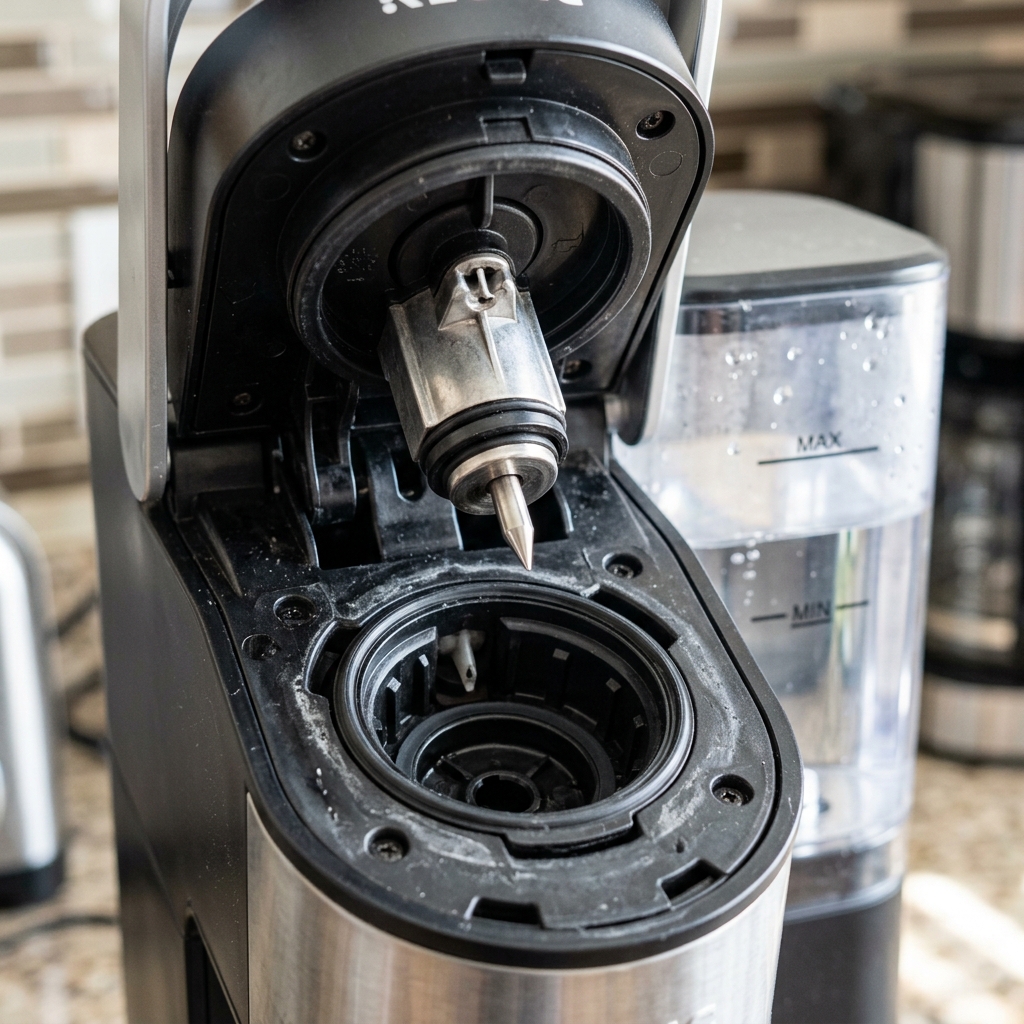
- The Pod Holder/Piercing Needle Assembly: The internal mechanism that actually punctures the pod frequently clogs or breaks. If you can safely detach it, it's a high-demand replacement part.
- The T-Disc Service/Cleaning Disc (Tassimo): Tassimo machines require a special yellow or orange plastic "cleaning disc" to run the descaling cycle. Users lose these constantly. They are tiny, cost nothing to ship, and sell for $8-$12 all day long.
Testing and Cleaning (If Selling Whole)
If the machine is in great cosmetic shape and powers on, you might decide to sell it whole.
- Power On: Does it light up? Do the buttons respond?
- Water Flow: Run a water-only cycle. Does the pump sound smooth or is it struggling? Does the water come out hot?
- Descaling: If the flow is slow, it likely just needs to be descaled (removing calcium buildup from hard water). 📦 Get Commercial Coffee Machine Descaling Solution on Amazon - A $10 bottle of descaler can save a "broken" $80 machine!
- Deep Clean: Clean every removable part thoroughly. Nobody wants to buy a coffee maker with old, crusty coffee grounds in it. A pristine machine commands a premium price.
Shipping Whole Machines
Shipping a whole coffee maker requires care. They contain glass/brittle plastic and internal water lines.
- Drain It: Run the machine completely empty. Some models have a specific internal drain process (check the manual online) to ensure no water leaks into the electronics during transit or freezes in cold weather.
- Remove Loose Parts: Remove the water tank, drip tray, and any loose accessories. Wrap them individually in bubble wrap and place them inside the box, not attached to the machine.
- Box Sizing: Use a sturdy box with at least 2 inches of clearance on all sides of the machine. Fill the void space tightly with heavy-duty packing paper or large-bubble wrap so the machine cannot shift at all during transit.
By learning to identify valuable discontinued models and understanding the "parting out" strategy, you can turn heavy, intimidating thrift store appliances into consistent, high-margin sales.